The $2,500-a-Month Revenue You're Leaving on the Table: A Contractor's Guide to SMS Marketing
Every month, the average Colorado contractor loses roughly five jobs to slow follow-up — $2,500 in revenue that walks out the door because nobody responded fast enough. This is the complete guide to building an automated SMS system that follows up with every lead in under 60 seconds and recovers that money without hiring a single person.
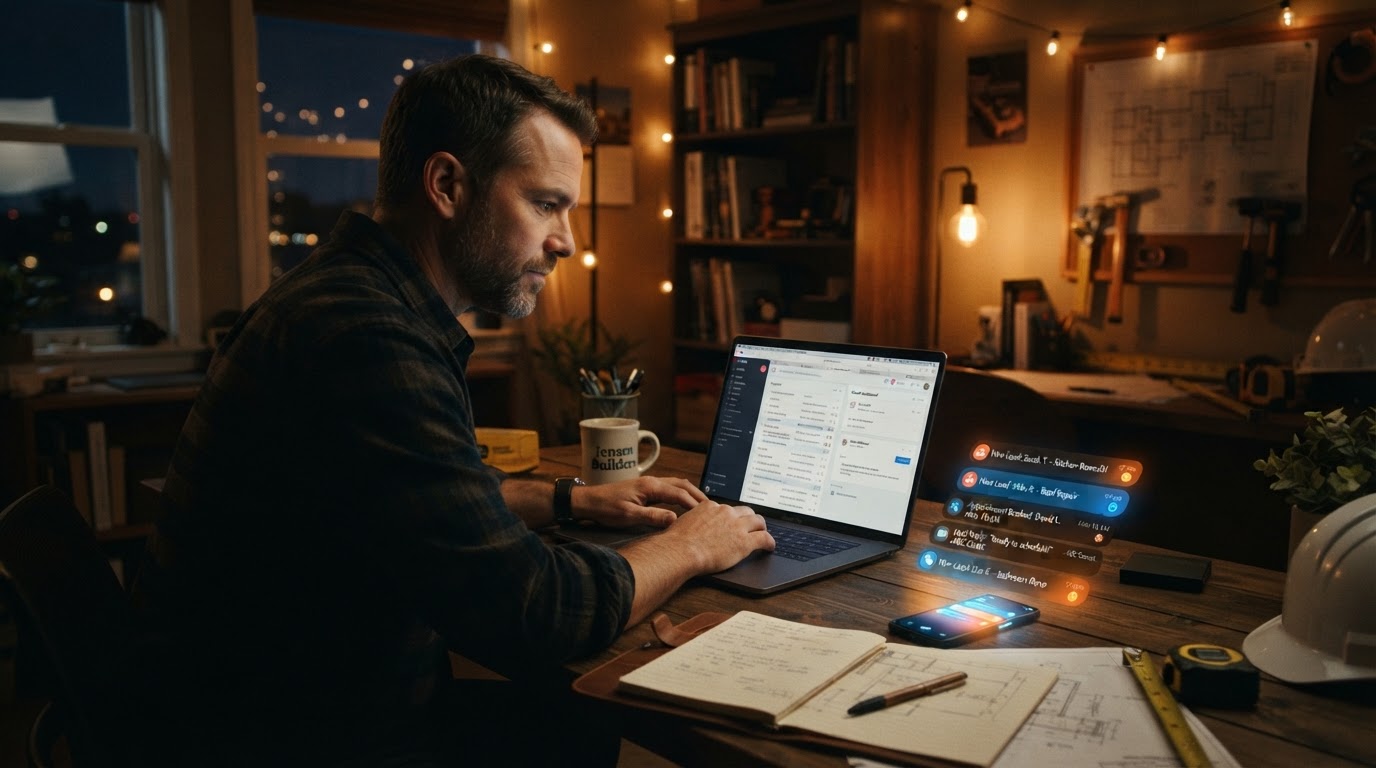
1. The $2,500 You Don't Know You're Losing
Here's a number that should keep you up at night: the average Colorado contracting business loses roughly five jobs every single month to slow follow-up. Not to better competitors. Not to cheaper bids. To silence. A homeowner fills out your contact form at 7 PM, you're on a job, nobody responds until the next morning, and by then they've already booked the contractor who texted them back in under a minute. Five jobs a month, at an average ticket of $500, is $2,500 in revenue walking out the door every 30 days — $30,000 a year — and you never even knew it happened.
The reason this happens is almost never a lack of effort. It's a lack of the right channel. Contractors have been trained to follow up by phone and email, but the data is brutally clear about where your customers actually live: their text message inbox. SMS has a 98% open rate. Email sits around 20%. A missed call goes to voicemail, which fewer than 20% of people ever listen to. The leads you're losing aren't ignoring you because they don't want your service — they're ignoring you because you're trying to reach them through a channel they stopped checking in 2015.
This is the complete guide to SMS marketing for Colorado contractors. By the end, you'll understand exactly why text messaging is the highest-ROI channel in home services, how to build a compliant automated SMS system that follows up with every lead in under a minute, and how to recover that $2,500 a month without hiring a single person or spending your evenings glued to your phone.
2. Why SMS Outperforms Every Other Channel
Let's start with the numbers, because they tell the whole story. When you send a text message to a lead, 98% of them open it — usually within three minutes. When you send an email, 80% of them never open it at all. When you leave a voicemail, most of them delete it without listening. The gap between SMS and every other follow-up channel isn't small. It's catastrophic. And for a contractor whose entire business depends on responding before the competition does, that gap is the difference between a booked job and a lost one.
SMS vs Email Open Rates
*Industry averages. SMS messages are read within 3 minutes on average, while the majority of marketing emails go unopened. Individual results vary by audience and message quality.
The reason SMS works so well is simple: it meets your customer where they already are. Nobody downloads a special app to receive your text. Nobody checks a separate inbox. The message appears on the lock screen of the device they're already holding, with a sound and a notification, and it demands attention in a way email simply cannot. For a homeowner with a broken furnace or a leaking water heater, that immediacy matters more than anything else. They want to know someone heard them. A text message says "we're on it" faster than any other medium.
There's also a psychological dimension. Email feels formal. A phone call feels intrusive, especially from an unknown number — which is why answer rates for cold callbacks have cratered. A text message sits in the sweet spot: personal enough to feel human, low-pressure enough that the customer can respond on their own time, and fast enough that the conversation keeps momentum. When a lead texts back "Thursday at 2 works," you've booked the job in two messages. Try doing that over email in under 48 hours.
3. The Revenue Math: How 5 Extra Jobs Become $30,000 a Year
Let's make this concrete, because abstract marketing advice is worthless if you can't see the dollars. Take a typical Colorado HVAC, plumbing, or electrical contractor. You get maybe 40 to 60 inbound leads a month from your website, your Google Business Profile, and your ads. Right now, you probably book 15 to 20 of them. The rest go cold — they filled out a form, you called once, they didn't pick up, and you moved on to the next lead because you're busy running actual jobs.
The $2,500/Month Revenue Math
Extra Jobs / Month
jobs
Average Ticket
$/job
Monthly Revenue
/mo
Annual Revenue
/yr
*Illustrative model. 5 additional booked jobs per month at a $500 average ticket = $2,500 in recovered monthly revenue. Actual figures vary by trade, ticket size, and response rate.
Now imagine you recover just five of those lost leads a month. Not fifty. Five. That's a 10% improvement in your close rate, which is conservative for a business that currently has no automated follow-up at all. At an average ticket of $500 — low for HVAC, realistic for a service call — those five jobs are $2,500 in monthly revenue you were already paying to generate but never collecting. Over a year, that's $30,000. For a one-man operation, that's a part-time employee. For a growing shop, that's a new truck payment. And the cost to recover it is a text messaging system that runs while you sleep.
The reason this math works so cleanly is that you're not spending more on marketing. You're not buying more leads. You're not running more ads. You're simply capturing the leads you already paid for — the ones slipping through the cracks because no human can follow up with 40 people within five minutes while also being on a roof. SMS automation doesn't add to your lead volume. It multiplies the value of the leads you already have.
4. The Speed-to-Lead Gap That's Killing Your Close Rate
Here's the statistic that should change how you run your business: leads contacted within five minutes are nine times more likely to convert than leads contacted after 15 minutes. Not 9% more likely. Nine times. The reason is human psychology — when someone fills out a form requesting a service, they're in a brief window of high intent. They're thinking about their problem right now. Fifteen minutes later, they've moved on to something else, and your callback feels like an interruption instead of an answer.
Response Time by Channel (Minutes to First Response)
*Average first-response times by channel based on contractor industry research. SMS leads dramatically because messages are read within minutes of delivery.
The problem is that no contractor can respond to every lead within five minutes. You're on jobs. You're driving. You're with customers. Even if you had a dedicated receptionist, they'd need to be watching your inbox every second of every day. The only system that can respond within five minutes to every single lead, every single time, day or night, weekday or weekend, is an automated one. And the only channel fast enough to deliver that response in a way the customer will actually see is SMS.
When a lead fills out your form at 9:47 PM on a Saturday, your SMS system fires a text at 9:47 and one second: "Hi John, this is SOYRA with Apex Plumbing. We got your request for a water heater estimate. Are you free for a quick call tomorrow morning?" The homeowner reads it on Sunday morning over coffee, replies "Yes, call me at 9," and you've booked a job that would have gone to whoever called them back on Monday — if they even still remembered which contractor they'd contacted.
5. Building a Compliant SMS Follow-Up System
Before we get into the sequences and the messaging, we have to talk about compliance, because SMS marketing is regulated and getting it wrong is expensive. The Telephone Consumer Protection Act (TCPA) requires that you have prior express written consent before sending automated marketing text messages. That means your lead capture forms — on your website, your landing pages, your ads — must include a clear consent checkbox disclosing that the user agrees to receive SMS messages, that message frequency varies, that data rates may apply, and that they can reply STOP to opt out. This isn't optional. It's federal law, and the penalties for violations start at $500 per non-compliant message.
The good news is that compliance is straightforward once you know the rules. Every form on your site should have a TCPA-compliant consent checkbox. Every automated message should include clear identification of who's texting. Every recipient should be able to opt out instantly by replying STOP, and your system should honor that opt-out immediately and automatically. When you build this correctly from the start, you get the conversion power of SMS without the legal risk. When you skip it, you're one complaint away from a problem you don't want.
There's also a practical compliance layer around message frequency. The fastest way to get marked as spam — and to burn a lead you could have booked — is to text someone six times in two days. A good SMS sequence respects the customer's attention. Four touches over four to five days, each one adding value or lowering friction, is the sweet spot. After that, you stop. If they haven't responded, they're not interested right now, and hammering them will only ensure they never respond later either.
6. The 4-Touch SMS Sequence That Recovers Lost Leads
This is the exact sequence we deploy for every contractor client. It's four messages spread over four to five days, each one with a specific job. The first message acknowledges the lead and opens the conversation. The second offers concrete time slots to remove decision friction. The third creates a low-pressure final push. The fourth gracefully closes the loop so you stay top-of-mind without being annoying.
The 4-Touch SMS Follow-Up Sequence
Touch 1
Immediate"Hi {name}, this is SOYRA with {business}. We got your request for a {service} estimate. Are you available this week for a quick call?"
Touch 2
1 hour"Hey {name}, just following up — we have an opening Thursday at 10am or 2pm. Which works better for you?"
Touch 3
Day 2"{name}, we'd love to earn your business. Reply YES to lock in your time slot or call us at {phone}. No pressure either way."
Touch 4
Day 4"Last note from us, {name}. If timing wasn't right, just reply LATER and we'll circle back next month. Otherwise we're here when you need us."
*Example automated sequence. Each message fires on a timed delay without manual effort. Personalization tokens auto-fill from your CRM.
Notice what this sequence does that most contractor follow-up doesn't. It never asks an open-ended question like "when are you available?" — because open-ended questions create work for the customer, and work kills conversions. Instead, every message offers a specific choice: Thursday at 10 or 2? Yes or no? Reply LATER for next month. The customer can respond with a single word, which means they actually will. This is the difference between a follow-up system that books jobs and one that just sends messages into the void.
The other thing this sequence does is personalize. Every message uses the lead's first name, your business name, and the specific service they requested — pulled automatically from your CRM. "Hi John, this is SOYRA with Apex Plumbing. We got your request for a water heater estimate" converts dramatically better than "Hi, thanks for contacting us." The personalization proves you actually saw their request, which builds the trust that makes them respond. And because it's automated, it happens identically for every lead, every time, without you typing a single word.
7. Missed Call Text-Back: The Single Highest-ROI SMS Feature
If you implement only one thing from this entire article, make it this: missed call text-back. When someone calls your business and you don't answer — because you're on a job, because it's after hours, because you're driving — your system automatically sends them a text within 60 seconds: "Hi, sorry we missed your call! This is SOYRA with Apex Plumbing. How can we help? If you need to book a service, reply here and we'll get you on the schedule."
This one feature alone recovers an enormous percentage of lost calls. The caller was already trying to reach you — they had high intent. By texting them back immediately, you capture that intent before it evaporates and before they dial the next contractor on the list. Most contractors who deploy missed call text-back see their recovered leads jump within the first month. It's the closest thing to free money in the entire marketing stack, because you already paid for that call. You just weren't collecting it.
The beauty of missed call text-back is that it works 24/7 without you. A call comes in at 11 PM on a Sunday. You're asleep. Your system texts back at 11:01 PM. The homeowner reads it Monday morning, replies to book, and you wake up to a job on your calendar that — without the text — would have gone to whoever they called next. This is what it means to have a system that works while you're on the job. It's not about working harder. It's about never letting a high-intent lead slip away because of timing.
8. Review Requests Over SMS: Doubling Your Google Reviews
SMS isn't just for lead follow-up. It's also the most effective channel for generating Google reviews, which directly drives your local search rankings and your conversion rate. The reason is the same open-rate math: a review request sent by email has a 20% chance of being seen. A review request sent by text has a 98% chance. When you ask for a review over SMS, at the right moment — 24 hours after a job is completed, when the customer has used your service and is still in a positive frame of mind — your review conversion rate multiplies.
The sequence is simple. Job completed. Wait 24 hours. Send a text: "Hi John, thanks for choosing Apex Plumbing! If we did good work, would you mind leaving us a quick Google review? It takes 30 seconds: [link]." Include a direct link to your Google review form so the customer doesn't have to search for it. If no review in three days, send one gentle reminder. Then stop. This single automated sequence is how contractors go from 12 reviews to 80+ in six months — and those reviews compound into higher rankings, more clicks, and more calls.
The compounding effect is what makes this so powerful. More reviews lead to higher Google Maps rankings. Higher rankings lead to more inbound calls. More inbound calls give you more completed jobs to ask for reviews. Each turn of the flywheel makes the next one easier. SMS is the engine that keeps it spinning, because it's the only channel fast enough and visible enough to actually get the review request in front of your customer at the moment they're willing to act on it.
9. Appointment Reminders: Killing Your No-Show Rate
There's one more SMS use case that pays for itself almost immediately: appointment reminders. Every contractor knows the pain of driving 45 minutes to a job only to find nobody home. No-shows aren't just wasted time — they're wasted revenue, wasted gas, and a schedule hole you can't fill on short notice. The fix is a simple automated SMS reminder sent 24 hours before the appointment and again one hour before: "Hi John, this is a reminder that Apex Plumbing is scheduled at your home tomorrow at 2 PM. Reply C to confirm or R to reschedule."
Contractors who deploy SMS appointment reminders typically cut their no-show rate by 50% or more. The customer who forgot about the appointment now remembers and confirms. The customer who needs to reschedule does it a day in advance instead of after you've already arrived. Either way, you recover time you would have lost. And because the reminder includes a one-letter reply option, the customer can respond without effort, which means they actually do.
The compounding effect here is on your schedule density. When your no-show rate drops, you can book your calendar tighter without fear of gaps. Tighter scheduling means more jobs per day, which means more revenue per week, without working more hours. SMS reminders are one of those unglamorous operational improvements that quietly add five figures to your annual revenue by eliminating waste you didn't even realize you had.
10. Common SMS Marketing Mistakes Contractors Make
Now that you know what to do, let's cover what not to do, because the most common SMS mistakes actively damage your business. The first is texting without consent. If you bought a list of phone numbers and you're blasting texts to people who never asked to hear from you, you're violating TCPA regulations and training your audience to mark you as spam. Every text you send should go to someone who explicitly opted in through one of your forms. Quality over quantity, always.
The second mistake is over-messaging. Four touches over five days is a sequence. Twelve touches over three days is harassment. Every additional message after the customer has stopped responding decreases the chance they'll ever respond and increases the chance they'll opt out. Respect the stop. When someone replies STOP, your system should immediately and permanently remove them from every sequence. No exceptions, no "one last message."
The third mistake is sending generic, impersonal messages. "Thanks for your interest!" tells the customer nothing and feels like a robot. "Hi John, this is SOYRA with Apex Plumbing about your water heater estimate" tells them exactly who you are, why you're texting, and what they asked for. Personalization tokens from your CRM make this automatic, so there's no excuse for sending a message that could have gone to anyone. The fourth mistake is not testing your links. A review request with a broken link is worse than no request at all, because it wastes the customer's goodwill. Test every link in every sequence before it goes live.
11. Putting It All Together: Your SMS System Blueprint
Here's the complete system, end to end. A lead fills out a form on your website with a TCPA-compliant consent checkbox. Your CRM instantly fires the first SMS within five minutes — ideally within 60 seconds. The 4-touch follow-up sequence runs automatically over the next five days, each message personalized and offering a specific choice. If the lead books, they enter your appointment reminder sequence. If they don't respond, the sequence ends gracefully and they stay in your CRM for future re-engagement.
In parallel, every missed call triggers an instant text-back. Every completed job triggers a review request over SMS 24 hours later. Every booked appointment triggers reminder messages 24 hours and one hour before. None of this requires you to touch your phone. None of it requires a receptionist. None of it requires you to remember to follow up. The system runs while you're under a sink, on a roof, or asleep at 2 AM. And every piece of it is recoverable revenue you were already paying to generate but never collecting.
The contractors who win in Colorado in 2026 aren't the ones with the fanciest websites or the biggest ad budgets. They're the ones who respond first, follow up automatically, and never let a single lead go cold. SMS is the channel that makes that possible, and an automated system is what makes it scalable. You don't need to hire staff. You don't need to work harder. You need a system that works while you're on the job — and that's exactly what we build.
Stop Losing Leads to Slow Follow-Up
See how an automated SMS system captures every lead, follows up in under 60 seconds, and recovers the $2,500 a month you're leaving on the table. Book your free 30-minute demo.
Book Your Free DemoSOYRA Growth Team
October 7, 2026 • 16 min read