Landscaping Business Growth: The Complete Marketing Guide for 2026
SOYRA Growth Team
June 17, 2026 • 12 min read
Mowing lawns might pay the bills, but custom hardscaping, outdoor kitchens, and complete landscape redesigns build wealth. To attract those $20,000 to $100,000 projects, your digital presence needs to reflect luxury, trust, and professionalism. Here is how the top landscaping companies in Colorado are dominating their local markets in 2026.
Why Landscaping Companies Struggle With Marketing
Most landscaping companies in Colorado don't have a marketing problem. They have a capture problem. They're good at the work — building patios, installing retaining walls, laying irrigation — but when a homeowner searches "landscaping company near me" in Denver or Aurora, the business that shows up isn't always the best one. It's the one with the best online presence.
Here's the thing: 89% of homeowners use search to find local contractors before they ever make a phone call. And 73% of them hire the first business that actually responds to their inquiry. That means two things keep food on the table for a landscaping company: being findable on Google, and responding fast when someone reaches out.
The landscapers losing revenue aren't losing it to competitors who do better work. They're losing it to competitors who show up first in search, have more five-star reviews, and answer the phone (or text back) within minutes. The good news is that every one of those levers is something a small business can pull — you don't need a big agency budget to win. You need the right systems.
The problem is that most landscapers treat marketing as a single thing. They either "do SEO" or "run ads" or "post on Instagram." In practice, the companies that grow treat it as a system: a website that converts, a Google Business Profile that ranks, automated follow-up that books the estimate, and a review engine that compounds trust over time. Break any one link in that chain and the leads dry up.
Building a Google Business Profile That Drives Calls
Your Google Business Profile (GBP) is the single most important online asset for a landscaping company. It's what shows up in the map pack — those three business listings at the top of Google when someone searches "landscaper Denver." Roughly 44% of local clicks go to the map pack, and most of the rest never scroll past the first page.
The settings most landscapers skip are the ones that actually move the needle. First, choose the right primary category. "Landscaper" is fine, but "Landscape designer" or "Hardscape contractor" can rank for more specific, higher-value searches. Then add every relevant service as a secondary category. The more specific, the better — "patio installation," "retaining wall contractor," "irrigigation system installation."
The Six Fields That Actually Matter
Complete every section of your profile. It sounds tedious, but Google rewards completeness. The fields that matter most for a landscaping company are the business description (use your keywords naturally — "custom hardscaping in Denver," "landscape design serving Aurora and Centennial"), the services list (add each one with a real description), the service area (list every city you serve, not just your home base), the hours (be accurate — mismatched hours cost you calls), and the photos.
Photos are where most landscaping companies leave money on the table. Profiles with 50+ photos get 35% more direction requests and 42% more calls than those with fewer than 10. Post before-and-after shots of completed projects, photos of your crew on site, and a handful of polished portfolio images. Update them monthly — Google treats fresh photos as a signal that your business is active and currently taking work.
Local SEO for Landscaping: Keywords, Service Pages & Citations
Local SEO for landscapers is not complicated, but it requires consistency. The goal is to show up when a homeowner in your service area searches for the exact services you offer. That means targeting transactional keywords — the phrases people type when they're ready to hire, not just browsing.
The Keywords That Actually Bring Jobs
Generic terms like "landscaping" are too broad and too competitive. Instead, target specific service-plus-city combinations. "Paver patio installation Denver," "retaining wall contractor Aurora," "landscape design Colorado Springs." These longer phrases have lower search volume individually, but they convert at a far higher rate because the searcher knows exactly what they want. A single $35,000 patio install booked from one of those searches pays for a year of SEO work.
Build a dedicated service page for each offering. Do not lump "Retaining Walls" and "Outdoor Kitchens" onto the same page — Google wants to send users to the most relevant, authoritative page for their specific search. Each page should cover the service in depth: what it includes, your process, average pricing, project photos, and a clear way to request a quote.
Citations and Consistency
Citations — your business name, address, and phone number listed on directories like Yelp, Bing Places, Apple Maps, and local chambers of commerce — signal to Google that your business is legitimate and locally rooted. The key is consistency: the exact same name, address, and phone across every listing. Mismatched NAP data is one of the most common reasons landscapers rank lower than they should. Audit your listings once a quarter and fix any drift.
Paid Advertising: Google Local Services Ads
Google Local Services Ads (LSAs) are the fastest way to get exclusive, high-intent leads for a landscaping company in Colorado. Unlike regular Google Ads, you pay per lead — not per click — and your listing shows up above everything else, including organic results and the map pack. A typical landscaping lead in the Denver metro area costs $15 to $30 through LSA, and because the leads are exclusive (not shared with five competitors like Angi), the close rate is dramatically higher.
The trade-off is that LSAs require the Google Screened badge, which means background checks and license verification. It takes a couple weeks to set up, but once you're approved, the badge is a trust signal that converts homeowners who are comparing three listings side by side. Run LSAs heavily in March and April when spring searches peak, and dial them back during the winter when the volume drops and the cost-per-lead stays the same.
Pair LSAs with your organic SEO. Ads fill the gap while your service pages rank, and once SEO matures you can reduce ad spend without losing lead volume. The landscapers who do both win the short term and the long term.
Website Conversion Tactics for High-Ticket Projects
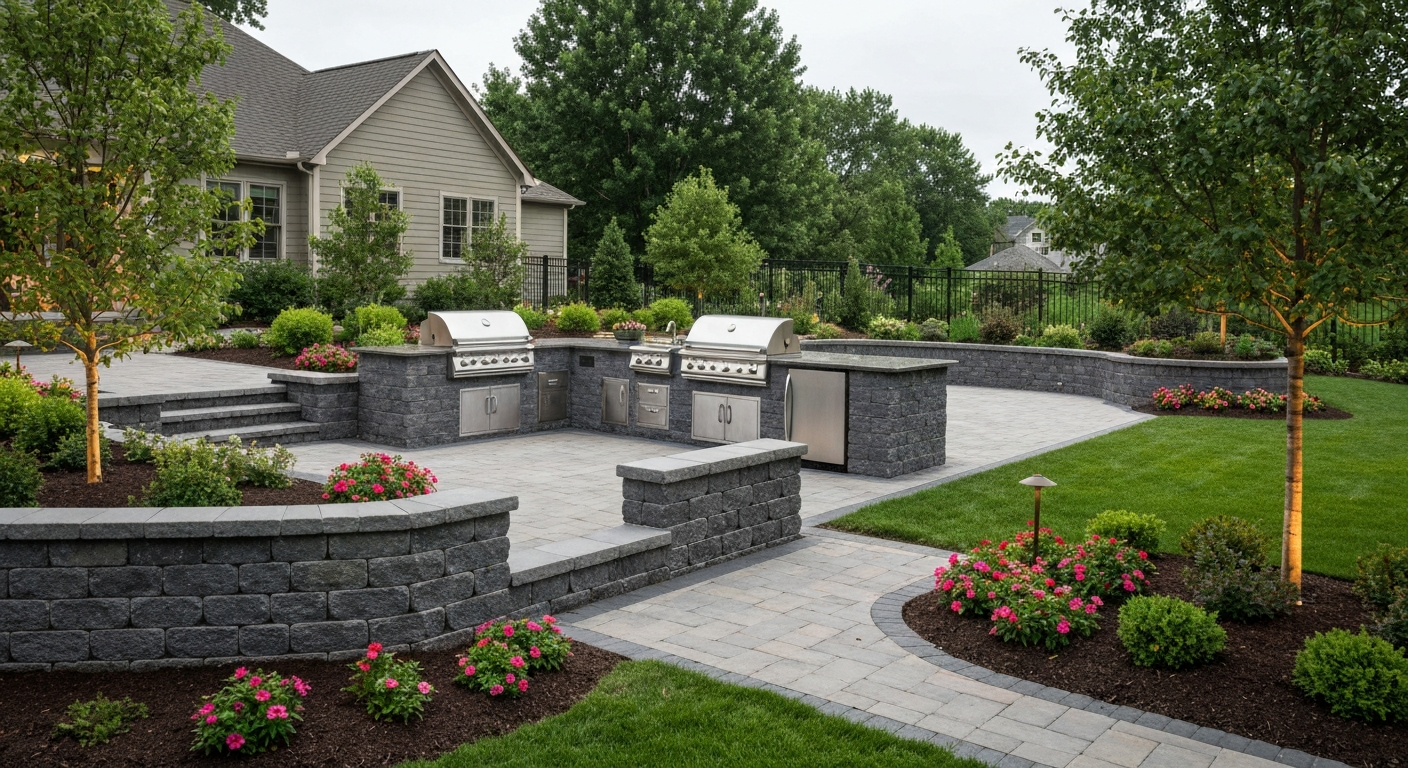
Unlike HVAC or plumbing, landscaping is intensely visual. Homeowners are buying a dream. If your website looks like it was built in 2015 and only features stock photos, you will lose high-ticket bids to competitors with sleek, portfolio-driven sites. For a $20,000 to $100,000 project, your website is the first impression that determines whether you even get the estimate call.
Visual Proof is Your Strongest Weapon
- High-Quality Project Galleries: Organize your portfolio by project type (Patios, Retaining Walls, Water Features). A homeowner searching for a patio doesn't want to scroll through 40 photos of lawn care to find one paver install.
- Before & After Sliders: Nothing sells a landscape transformation better than an interactive before-and-after slider. It makes the value tangible in a way that two separate photos never can.
- Clear Pricing Guidance: You don't need to publish exact prices, but giving a range ("custom patios starting at $18/sq ft") qualifies leads before they call and weeds out the price shoppers who were never going to book anyway.
- Mobile-First Forms: Over 60% of local service searches happen on mobile. If your quote form is clunky on a phone, the lead bounces to the next result. Keep it short: name, phone, project type, and one open field.
Every page should have one clear primary call-to-action — usually "Request a Quote" or "Book a Consultation" — visible without scrolling. Secondary CTAs like "View Portfolio" or "Read Reviews" support it. The moment a homeowner has to hunt for how to contact you, you've lost them.
Social Media & Before/After Content Strategy
For landscapers, social media is not about going viral — it's about proof. Instagram and Facebook are where before-and-after content lives, and that content is the closest thing to standing in a client's yard and showing them what's possible. A consistent feed of project transformations, in-progress shots, and finished work builds the trust that closes high-ticket jobs.
Post three times a week at minimum. One before-and-after carousel, one in-progress "behind the scenes" reel, and one finished-project photo with a caption about the project's details — the city, the scope, the timeline. Tag your location. Colorado homeowners browse Instagram for local inspiration; showing up in their feed week after week keeps you top-of-mind when they're ready to hire.
The biggest mistake is treating social as a separate channel. Pull the same before-and-after photos onto your website's portfolio, your Google Business Profile, and your email follow-ups. One project, repurposed across five touchpoints, compounds the trust you build with almost no extra effort.
Automating Follow-Up & Lead Nurturing
Landscapers waste countless hours driving to properties for estimates that go nowhere. By implementing smart intake forms on your website, you can pre-qualify leads before you ever put the keys in the ignition. Require prospects to select their budget range, timeline, and project type. Connect this form directly to your CRM to trigger automated follow-up sequences, ensuring no high-value lead slips through the cracks while you're out in the field.
The moment a form is submitted, an automated text should go out within 60 seconds: "Thanks for reaching out — I'll call you this afternoon to schedule the estimate. In the meantime, here are a few recent projects similar to what you described." That one message does three things: it acknowledges the lead instantly, it sets expectations, and it buys you time. Most homeowners will wait for the landscaper who responded at all over the one they're still waiting to hear back from.
After the estimate, a structured follow-up sequence keeps the job warm. Day one: a recap email with the quote and a timeline. Day three: a text checking in. Day seven: a message offering to answer any questions. The data is clear — 80% of sales require five or more follow-ups, but most landscapers give up after one. An automated CRM sequence makes sure you're the one who follows up the fifth time, not your competitor.
Reputation Management & Reviews
Reviews are the engine that compounds every other marketing effort. A landscaping company with 80 five-star Google reviews converts roughly twice as many website visitors into estimate calls as one with 12 reviews. Reviews don't just build trust — they directly influence where you rank in the map pack, because Google treats review volume and recency as a ranking signal.
The system that works: automate the review request the moment a project is marked complete in your CRM. Send a text with a direct link to your Google Business Profile within an hour of finishing, while the client is still looking at their new patio. Colorado homeowners are generous when the timing is right. Companies that follow this pattern reach 50 reviews within their first year.
Respond to every review — positive and negative. A thoughtful response to a five-star review reinforces the goodwill; a professional response to a one-star review shows the next homeowner who reads it that you stand behind your work. Both signals matter to the customer deciding whether to call you.
Grow Your Landscaping Business
Transition from low-margin maintenance to high-ticket hardscaping with a website designed to attract premium clients, automated follow-up that books estimates while you're on site, and a review engine that compounds trust month over month.
Frequently Asked Questions
The Bottom Line for Colorado Landscapers in 2026
Here's what actually works for landscaping companies in Colorado right now. It's not one big move — it's a system. A Google Business Profile that's complete and photo-rich gets you into the map pack. Dedicated service pages for each high-ticket offering capture the specific searches homeowners are typing. A fast, mobile-friendly website with a clear call-to-action turns those searches into estimate requests. Automated follow-up books the estimate while you're on a job site, and a review engine compounds trust so the next homeowner who finds you already trusts you.
The landscapers winning in Denver, Aurora, Colorado Springs, Fort Collins, and Boulder aren't doing anything magical. They showed up on Google, they responded faster than the next company, they followed up one more time than their competitor did, and they asked for reviews at the moment their client was happiest. Every one of those steps is repeatable, automatable, and within reach for a business owner who's willing to treat marketing as a system rather than a one-off project. Set up the foundation this winter, and by the time spring searches peak in April, you're the landscaper at the top of the list.